Console History
Consoles are considered one of the game home gaming systems of all time. Families would be able to spend quality time together playing video games. Also it provided people with a means to play video games and potentially meet and befriend new people online. One disadvantage is that they are quite pricey compared with other ways to kill time/hobbies. Another disadvantage to consoles are that they always require a constant power source from a wall socket to power up.
Magnavox Odyssey 1972
One of the first Video Games Consoles, known as the Magnavox Odyssey, was created by a small team of people led by Ralph H. Baer at Sanders Associates and released by Magnavox in the United States in September, 1972 then was released overseas in 1973.
The system can be powered by six C batteries, which were included on purchase of the device however, an optional AC power supply was sold separately. The device lacked sound capability so you could only see what was happening not hear. Compared to today's graphics within video games the Magnavox Odyssey does not meet that standard but as the first video games console that can be expected. The display that you would see on the TV would be made up of dots and lines to make up games like Tennis, Hockey and a bunch of other games.

Magnavox Odyssey Commercial Video
Nintendo Entertainment System (NES) 1983
The Nintendo Entertainment System, also known as the NES, is an 8-bit home video game console that was developed and manufactured by the Japanese company, Nintendo. It was initially released in Japan on July 15, 1983, and was later released in North America during 1985, in Europe during 1986, and Australia in 1987. Over the consoles shelf-life, it sold 61.91 million consoles worldwide. This console is of the Third Generation and was known as the most popular console of its time until it was succeeded by the Super Nintendo Entertainment System, aka SNES.
The NES uses a 72-pin design. Originally, NES cartridges were held together with five small slotted screws. Games released after 1987 were redesigned slightly to incorporate two plastic clips molded into the plastic itself, removing the need for the top two screws.


Nintendo Entertainment System Commercial
Xbox Console 2001
The Xbox is a video game console and is the first installment in the Xbox series of consoles manufactured by Microsoft. It was released on November 15th, 2001, in North America then followed by Australia, Europe and Japan in 2002. The Xbox, graphically powerful compared to its rivals, featured a 733 MHz Intel Pentium III processor. It was also very big and heavy and was the first console to feature a built-in hard disk.
In November 2002, Microsoft released Xbox Live which is a monthly fee based subscription which allows the player to connect to other players online if the game they are playing supports online multiplayer. The Xbox had specific launch games even some that are exclusive to the Xbox brand. Some of these titles were called, Halo: Combat Evolved, Project Gotham Racing, and Dead or Alive 3.

Xbox/Xbox Live Commercial Video
PlayStation 4 2013
The PlayStation 4, also known as PS4, is a video games console developed by Sony Interactive Entertainment. The PS4 was released on November 15, 2013, in North America, and November 29, 2013, in Europe, South America and Australia, and February 22, 2014 in Japan. It is apart of the eighth generation with the Xbox One and the Wii U.
 http://sonic.wikia.com/wiki/PlayStation_4
On 7th, September 2016, Sony released two new hardware revisions to the PlayStation 4, a slimmer version to make it less smaller to the original model and the Pro version that allows support of 4K gameplay by upgrading the GPU and making the CPU clock rate higher.
On 7th, September 2016, Sony released two new hardware revisions to the PlayStation 4, a slimmer version to make it less smaller to the original model and the Pro version that allows support of 4K gameplay by upgrading the GPU and making the CPU clock rate higher.

In March 2014, Sony gave us information of their plan to be working on the 'PlayStation VR'. This device is planned to be available to be purchased October 13th 2016 at a steep price of $399.99 of the headset alone however if you pay $549.99, you can receive the PlayStation Camera, two PlayStation Move handsets and a free game all within that price.

PlayStation 4 Commercial Video
 |
 |
 |
|
Year of Introduction and
Generation
|
The PlayStation 4 was released on November 15, 2013. The PlayStation is the
Eighth Generation of consoles.
 |
The Xbox One was released on November 22, 2013. The Xbox is the Eighth Generation of consoles
 |
The Nintendo Wii was released in Japan on 2nd
December,
2006. In America on November 19th 2006. In Europe on December 8th,
2006.
 |
Processing
|
The PlayStations processor is an AMD (8 Core) Processor
|
The Xbox One has a 8 Core AMD custom CPU
|
The Wii has a IBM PowerPC Broadway processor
|
RAM
|
The PlayStation 4 has a GDDR5 SDRAM
|
The Xbox One has a 8GB DDR3
|
The Wii uses a 88MB 24MB MoSys 1T-SRAM as its RAM
|
Graphics
|
The PlayStation 4’s Graphics
run of the Semi-custom AMD GCN Radeon (integrated into APU)
|
The Xbox One runs this GPU 853 MHz (Xbox One), 914 MHz
|
The ATI "Hollywood" 243 MHz GPU is what the Wii uses.
|
Storage Media
|
You can buy a PlayStation 4 that has a Hard drive that stores 500 GB
of data or you could buy the upgraded version that stores 1 TB of data at an
increased cost.
|
With your purchase of an Xbox One you get a 500 GB Hard Drive and if
you require more space to store data you can buy external hard drives.
|
The Wii is able to store 512 MB Internal flash memory but if you
required more storage SD Cards are available for purchase.
|
Connectivity
|
The PlayStation 4 uses 802.11 b/g/n Wireless. It also has a Bluetooth
2.1 connection. It has 2 x USB 3.0 port. You can connect to the Internet via
a Ethernet 10/100/1000 connection.
|
The Xbox One uses Wi-Fi IEEE 802.11n. The Xbox One also allows you to
connect to the internet via Ethernet. There are 3× USB 3.0 ports on the
console which is used for charging you controller and other peripheral. You connect to your TV via a HDMI 1.4
in/out port and you can connect your Kinect accessory through the Kinect port
|
The Wii uses Wi-Fi IEEE 802.11 b/g. It also uses a
Bluetooth connection.
There are also 2 × USB 2.0 ports. You could also connect to the
internet with an Ethernet through the LAN Adapter.
|
Target Audience
|
The PlayStation 4’s target audience is really anyone who is into
playing games. There are also options to watch things like Netflix and
Youtube if the person is not that into playing games.
|
||
Other features (eg all
round entertainment )
|
Handheld Devices.
With Handheld devices there are alot of positives and a few limitations. One positive is that you can use it anywhere you want as it is very portable. Another positive is that you don't require other equipment to play e.g T.V. etc. One limitation is that you are required to charge the device (Unless it requires battery's as its power source. Another limitation is that it can be rather awkward to play with friends online. You can do this either over LAN wifi or by using products like the Link Cable for the Nintendo DS device so you have to spend even more money just to play with friends.
The timeline of handheld devices.
With Handheld devices there are alot of positives and a few limitations. One positive is that you can use it anywhere you want as it is very portable. Another positive is that you don't require other equipment to play e.g T.V. etc. One limitation is that you are required to charge the device (Unless it requires battery's as its power source. Another limitation is that it can be rather awkward to play with friends online. You can do this either over LAN wifi or by using products like the Link Cable for the Nintendo DS device so you have to spend even more money just to play with friends.
The timeline of handheld devices.

The very first handheld device was called the Microvision. It was released in 1979 with 4 launch titles games, Block Buster, Bowling, Connect Four and Pinball. The console didn't last too long as the device got discontinued in 1981 so it only lasted 2 years. The device works by using interchangeable cartridges. Each cartridge had different games on them so every time you wanted to play something different you had to change the cartridge. The following years that the device was released a few more of these cartridges where released. Later on in 1979 3 more games came out, Mindbuster, Star Trek: Phaser Strike and Vegas Slots. In 1980, 2 games were released named, Baseball and Sea Duel. Two more games where released in 1981 called, Alien Raiders and Cosmic Hunter. The last game ever released was in 1982 and was named Super Blockbuster. Below is the first commercial for the Microvision back in 1979.
Microvision's Commercial,

One of the next portable handheld devices is the Gameboy. This device is an 8 Bit device that is developed by Nintendo. It was originally bundled with Tetris. The Gameboy has four operational buttons, 'A', 'B', 'SELECT' and 'START', as well as the directional pad. This device was also battery operated. There was quite a few launch titles for the Game Boy, Super Mario Land, Alleyway, Baseball, Yakuman, Tetris and Tennis. The games on the Game Boy are cartridges. You place this cartridge into the top of the device.
Game Boy's Commercial.
Further on in the handheld timeline.

The Nintendo DS is a 32 Bit, dual screen portable handheld device. The device was on sale in North America first in November 21st 2004. The 'DS' short for Developers System or Dual Screen features two LCD screens working in tandem, the bottom screen is a touchscreen. It also has a built-in microphone and has support of wireless connect-ability. As of March 31, 2016, all Nintendo DS models combined have sold 154.02 million units, making it the best selling handheld game console to date, and the second best selling video game console of all time.
Nintendo DS Commercial
Latest in the handheld history.

New Nintendo 3DS Commercial
Arcade
Arcade Machines were made to be played by the public in amusement arcades. These machines were coin-operated and the size of them were quite bulky. The games that were created for these machines are quite varied from racing games to horror/survival. Arcade machines did have a few limitations to them, first of all the fact of the machines being coin-operated made it quite irritating for the public to play as you need a bunch of change to have an enjoyable time. Another limitation is the size, the size of them really hinder there portability from one spot to another.
Galaxy Game 1971
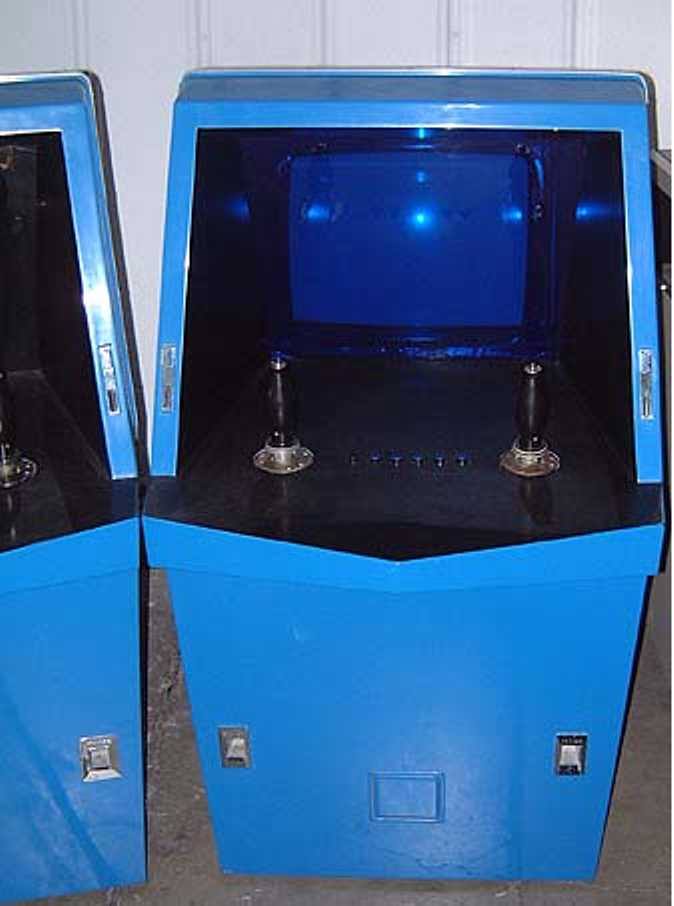
Galaxy Game is one of the first arcade games ever created for arcade machines. This game consist of two spaceships, each controlled by a player, shooting at one another trying to destroy the opposing ship. The ships have limited amount of bullets as well as limited amounts of fuel. Each player controls one of the ships and must attempt to shoot down the other ship while avoiding the star or else you lose a life.

Galaxy Game 1971 Video
Pac-Man 1980
Pac-Man is a arcade game which was created by Namco in May 1980. It was created by Japanese video game designer Toru Iwatani. The player controls Pac-Man through a maze, eating pac-dots. When all pac-dots are eaten, Pac-Man is taken to the next stage. Four enemies Blinky, Pinky, Inky, and Clyde move around the maze, trying to catch Pac-Man (You).

Pac-Man 1980 Video
Star Wars Battle Pod 2014
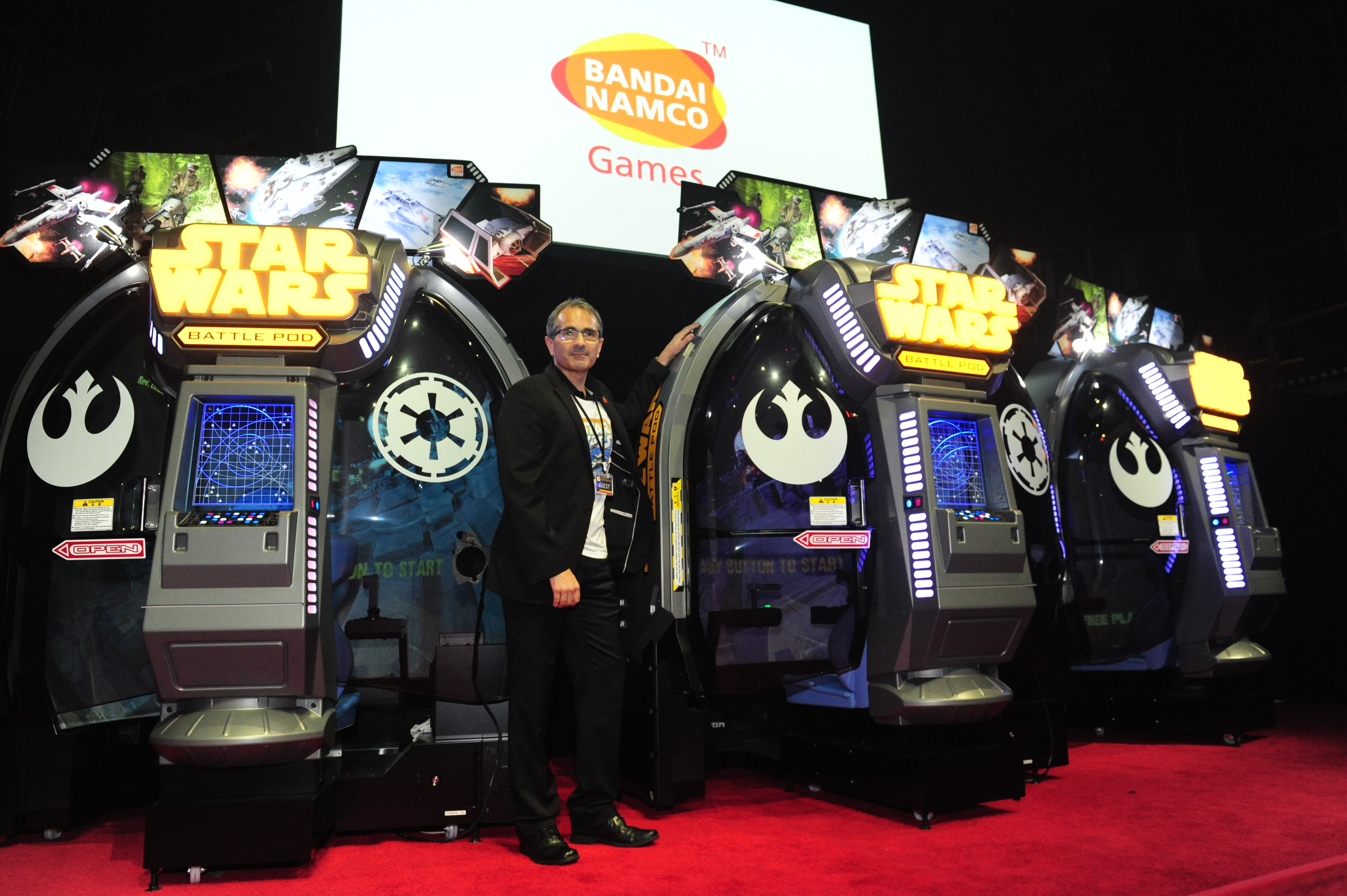
Star Wars Battle Pod is a arcade game which was created in 2014. The game has multiple scenarios that correspond with some of the battles in the original trilogy. There are five scenarios, the Battle of Yavin from Star Wars where you are placed in an X-wing attacking the Death Star to prevent if from destroying Yavin 4, the Battle of Hoth, from The Empire Strikes Back,

Star Wars Battle Pod 2014 Video
PC Gaming Timeline
PC Gaming is probably the most popular platform for playing games in today's society. You get the free movement from the mouse compared to the thumb stick's on a console controller. However, PC Gaming has a few limitations, for example; Games are changing become more graphically improved and technologically advanced which means your PC may need the specifications upgrading to be able to run/enjoy these games.
Commodore PET 1977
The Commodore PET, Personal Electronic Transactor, is a line of personal computers produced starting in 1977 by Commodore International. A top-seller in the Canadian and United States educational markets. One of the PC's that followed this is the Commodore 64. The first model, which was named the PET 2001, was the first personal computer ever made available for purchase. You could not hear any sound from this machines except bleeps.

Commodore PET 1977 Video
Apple III 1980
The Apple III is a business oriented personal computer produced by Apple Computer that was meant as the successor to the Apple II series, but was considered a failure in the market. Development work on the Apple III started in late 1978 by Dr. Wendell Sander. It had the code name of Sara named after Sander's daughter. The machine was announced and released on May 19, 1980 but due to serious stability issues that the machine needed a design overhaul. It was formally reintroduced in the second half of 1981. Development stopped and the Apple III was discontinued on April 24, 1984.

Apple III 1980 Video
iMac G3 1998
iMac is a range of Macintosh desktop computers designed and built by Apple Inc. It has been the primary part of Apple's consumer desktop offerings since its debut in August 1998. The announcement of iMac in 1998 started controversy and anticipation among the community, Mac fans, and detractors. Opinions were divided over Apple's drastic changes to the Macintosh hardware. At the time, Apple had suffered a series of setbacks as consumers increasingly opted for Wintel aka Windows PCs machines instead of Apple's models.

iMac G3 1998 Video
All of iMac's models to date

Hardware Technologies Table
Technology:
|
Reference:
|
Description & Why Important to
Gaming:
|
Image:
|
Human Computer Interface
|
“Also see GUI (graphical user interface). HCI (human-computer
interaction) is the study of how people interact with computers and to what
extent computers are or are not developed for successful interaction with
human beings.”
|
The HCI is Important
to gaming as the connection between the player and the computer is what makes
games fun to play. The interface will change from between different video
games which allows for more variety for example, a VR headset will make the
video game you’re playing a more investing experience.
|
|
Central Processing Unit (CPU)
|
“The CPU (Central Processing Unit) is the part
of a computer system that is commonly referred to as the "brains"
of a computer.”
|
The CPU is important to gaming as it is what reads all the tasks you
do and processes it so the computer can receive it. CPU’s are being created
annually as previous generations are becoming outdated and better ones are required
to run some of today’s programs and software which can be thought of as a
limitation to PC gaming.
|
|
Graphics Processors (GPU)
|
“A graphics processing unit (GPU), also occasionally called visual
processing unit (VPU), is a specialized electronic circuit designed to
rapidly manipulate and alter memory to accelerate the creation of images in a
frame buffer intended for output to a display.”
|
The GPU is important to gaming as it is what is needed to run the
more graphically demanding games. The better one you have the better quality
graphics you can run your video game at. Same as the CPU’s, GPU’s are being
upgraded quite frequently as the games of today require a fast/better
graphics card to run which can be thought of as a limitation to PC gaming.
|
|
Memory (RAM)
|
“Alternatively referred to as main memory, primary memory, or system
memory, Random Access Memory (RAM) is a hardware device that allows
information to be stored and retrieved on a computer.”
|
RAM is important to gaming as it allows for more processes and
temporary storage which is need to run applications like video games. When
inserting RAM into your PC it will only slot in one specific way due to the
split on the bottom of the card. Different makes have different slot
lengths/places which also leads into a limitation, some motherboards are not compatible
with some RAM creators. Another limitation is that if power gets cut off from
your PC the temporary data that is stored on the RAM will be lost/corrupted.
|
|
Display
|
“A display is a computer output surface and projecting mechanism that
shows text and often graphic images to the computer user, using a cathode ray
tube ( CRT ), liquid crystal display ( LCD ), light-emitting diode, gas
plasma, or other image projection technology.”
|
The display
is one of the most important parts of the gaming. It works with the Graphics
Card to provide a digital display for the user to see. A limitation is
that if you want to get top graphics then you need to pay for a high end
monitor.
|
|
Sound
|
“A sound card (also referred to as an audio card) is a peripheral
device that attaches to the ISA or PCI slot on a motherboard to enable the
computer to input, process, and deliver sound.”
|
The sound card is used to deliver sound to the user either though a
built in speaker or other peripherals like a headset or a speaker. Sound
cards are being created improved and better to the previous editions to meet
with today’s quality. You could have a high end sound card and the worst
speakers and the audio will still come out terrible so I consider this a limitation.
|
 |
Game Storage Media
|
“In computers, a storage medium is any technology (including devices
and materials) used to place, keep, and retrieve data.”
|
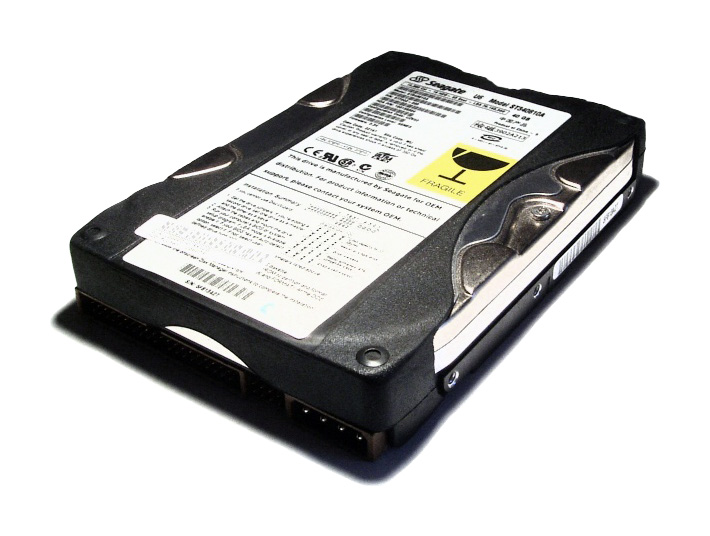
This is very important to gaming as it is used to store you video
games and any progress that you may make in those games. Storage varies
depending to the price your willing to pay. For example, you can get 500GB
hard drives and a 2TB ones which is about 4x the storage of the 500GB. This
could be a limitation.
|
|
Interface Devices
|
“An interface device (IDF) is a hardware component or system of
components that allows a human being to interact with a computer, a telephone
system, or other electronic information system.”
|
An interface device can be important to video games depending on the
game you play. If you play racing games with a USB steering wheel to make it
a more immersive environment same goes with a VR headset and the Kinect. A
limitation is that this is another thing that requires your hard earn money
for.
|
|
Connectivity
|
“A generic term for connecting devices to each other in order to
transfer data back and forth. It often refers to network connections, which
embraces bridges, routers, switches and gateways as well as backbone
networks.”
|
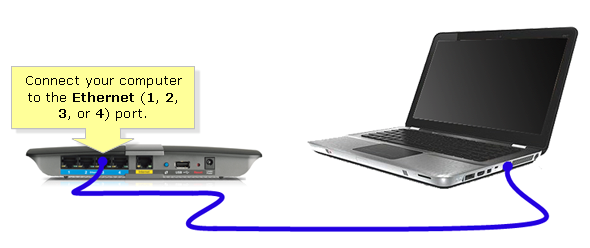
Connectivity has become more and more important to recent generations
of gaming as most of the video games of today have an online game mode which
requires the internet to allow you to play. A limitation is that you may not
have space near your Router to put your PC so you may have a hard time
getting an Ethernet cable to it.
|
|
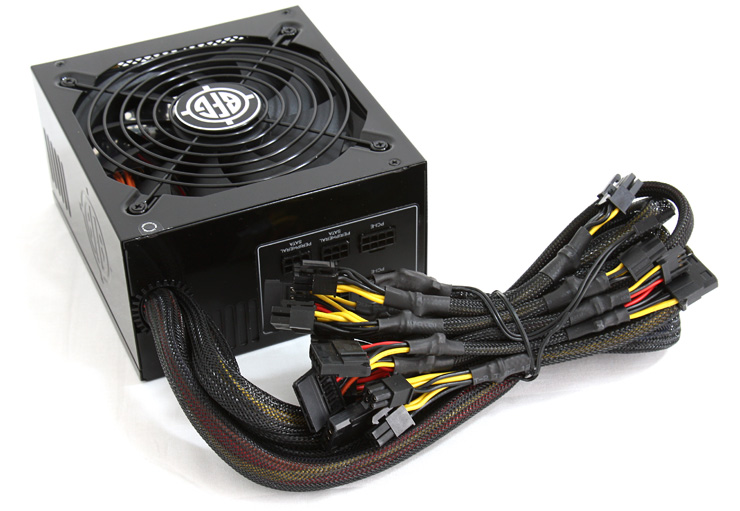
Power Supply (PSU)
|
“A power supply is an internal hardware component that supplies
components in a computer with power.”
|
The PSU is a vital part to gaming. It is what powers up a console or
whatever device you are playing games on. Different PSU’s have a different
Watt amount. The more stuff you have hooked up to your PC the more Watt you
will need. E.g. dual monitors etc. I would call this a limitation.
|





.png)

Television Gaming
Television Gaming is a very understated form of playing video games. You can purchase either a device like the Apple t.v or a one time subscription to a channel from your television provider e.g. Sky Games Channel. The limitation to TV gaming is that there is only a small amount of things you can do for it to run well with the hardware and equipment provided e.g. the sky remote.

Sky Games Channel
Sky Games Channel was a TV channel that was available for Sky owners which allows the user to play streamed games on their TV using their Sky remote as a controller. The games changed every week or so but from my experience a game called Beehive Bedlam was a popular game on there. The cost of this service was around £4-5 and you had access to this for the rest of the day after that you would have to pay again to regain access.
